Author: Pavan

  • “Pain with reflection” = ” awesome Growth”!

    This is an idea has had a huge impact on me, a long time back unknowingly and now knowingly. I will try to discuss only the emotional pain, causes and some remedies to deal with it. Also, in many cases, even physical pain can be managed if we can handle the emotional pain well! 

    I always try to learn from the best minds in the respective areas, as books have helped to do that in a big way. But pain is one aspect which can be best learnt by our own selves. I have been reading a lot last year, life, philosophy(Hindu, Buddhism, Christianity, Sufism),  Work-related books, self-help, and sometimes fiction(read 21 books in 2018). I will try to get into the nitty-gritty from various sources, observations of people and of self. 

    The best we can do is embrace the pain and accept it to make our selves better. Pain is something we all try to avoid, we try to run away from it. Ones you encounter with pain, instead of ignoring, take it up in a way to enable you to find a solution for progress.  Ones you realize how effective it is to accept the pain in an open manner and reflect upon it, you will completely change the way you be in a painful situation next time. Instead of running away from it, we can accept it, identify it, reflect upon it and learn how to better ourselves and in turn deal better with it.

    Emotional Pain can be from any reason it can be caused by our Personal or professional life. When we do experience pain, we have two choices, either to accept it or continue in our delusion by ignoring it. The most important thing to keep in mind during these moments is “to catch hold of it with awareness without a reaction”. It’s definitely not easy to realize it in that particular moment. But we can definitely at least note it and reflect upon it later.  You would come across a lot of people who would gift you, “tough love”.  A lot of moments you would get your blind spots from others. It is also a fact we don’t readily accept our own weakness easily and are also not aware of them. A simple strategy can be helpful for this. If we accept our weakness does not mean that we become them. We are definitely not our weakness forever, it, in turn, gives you the opportunity to get better with. It can enable you to work our on solutions to enable progress. But always remember we can’t improve what we can see(our blind spots), which gives us an open reason to accept criticism without judgements.  

    We have been in tough and painful moments a lot of times. I have personally been in many unlimitedly, previously being driven by my unaware emotions, I have never been able to understand, the only thing I had done was an unconscious reaction. Even some of you may recollect some moments in your work dealings(daily activities), personal relationships(family, romantic, friends, colleagues, daily interactions, etc). Do any of them in your previous situations make you realize your own blind spots? If your answer is yes. We need to start embracing those uncomfortable situations in better ways, be assured the discomfort is temporary but the progress thereafter is “Awesome”. Its a tough choice we make at the moment of pain, the easier choice we have further.  

    A deeper understanding via scriptures of various books would help us know that pain does exist but we purely misunderstand it. The only problem in life and the pain is, life isn’t happening the way you want it to happen. Is there any other problem? If we look into a deeper perception, aren’t we just reacting to our sensory impressions stored within our minds? If we understand it further, we are just reacting to the thoughts which come into our minds stored previously from past experiences. A simple way to keep this point clear within us by understanding a basic rule, we are not our body, nor our mind which is created via unconscious impressions, neither our thoughts nor our pain. Thus, our pain cannot define us and identify to ourselves. The best way is to be proactively receptive to the pain without judgement and immediate unconscious reaction. It can be explained by a simple analogy, imagine yourself driving a car,  as a higher self than your hands(thoughts steering), accelerator(thoughts), now if you allow the accelerator, and steering controlling you, would you be able to drive safely? The same we can try hard not to get driven by our thoughts, mind, emotions, pain unconsciously.  Instead, just observe and react as per our control to have a sane and safe drive! 

    Just copying a useful quote:

    “A transition is always painful
    From filth to cleanliness
    From darkness to light
    From falsehood to truth
    However, the discomfort is temporary

    When you get used to the new state you wonder how and why you put up with filth, darkness and falsehood for so long
    You’ll never go back!”

    Also, I wrote about Errors, mistakes, previously, check it out. I suggest similar remedies like Yoga, Meditation, Conscious awareness, non-judgement to catch hold of the pain, reflect, act and progress awesomely! Cheers!

    References: Principles(Ray Dalio), My Gita(Devdutt Pattnaik), Power of Now(Eckhart Tolle), The Bible(Audio), and a lot of more books I have read and learnt from. 

  • Intuitions, Impulsiveness, errors, mistakes –– the science behind it!

    Intuitions, Impulsiveness, errors, mistakes –– the science behind it!

    I have been intuitive and impulsive for most of early life, which has got me into trouble on a lot of occasions. I have been lucky to receive tough love several times from special people in my life and realize some of my shortcomings. This leads me to read (have been able to finish 21 books in 10 months) books. I have never been a reader, thanks to Kindle and Audiobooks which has encouraged me to become more comfortable with books. The best part about books, is the best thinkers of the last few thousand years tell you their nuggets of wisdom. There are several ways you can apply and use the concepts you learn. I will just try to put in some techniques which could help in better decision-making process enabling to reduce mistakes and errors. Making a mistake is not a problem, not learning from mistakes is a problem, and must admit I have learned slowly. Building a foundation is hard work. The key here is brutal honesty with yourself about what you really know and applying yourself using the science you learn. I will try to point out the source/science of the process leading us to errors and mistakes from a few books I read.

    In the book “Thinking, Fast and Slow

    Daniel Kahneman shows how the mind works and offers practical and enlightening insights into how choices are made in both our business and personal lives–and how we can guard against the mental glitches that often get us into trouble.

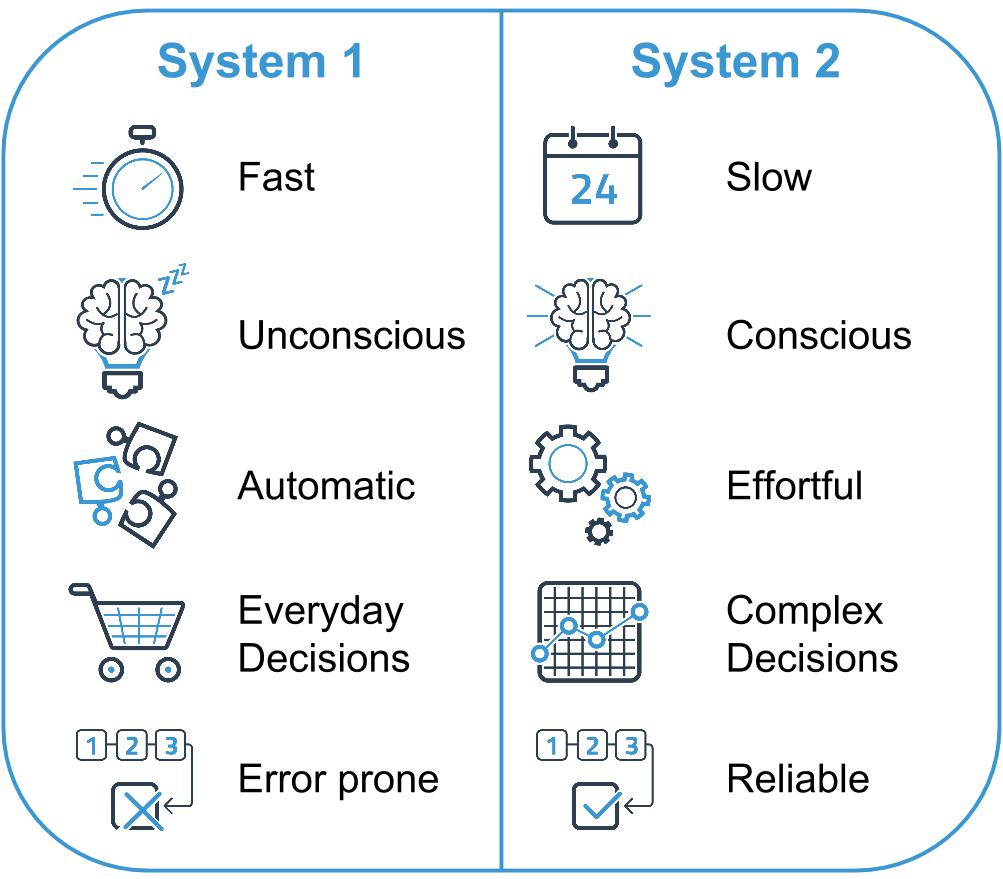
    Kahneman talks about two imaginary characters in our mind:

    System-1-vs-System-2

    We have an impulsive, emotional, and intuitive decision-making system he calls as System 1. A deliberative, reasoning, and (sometimes) rational decision-making system as System 2.

    He says “Intuition is nothing more and nothing less than recognition of these silent stored pieces of information. These are just thoughts which have been there before and not which you may like them to be. Intuition is the recognition of something we’ve seen before, we recognize a situation and we know how to respond because our brain sees the pattern and relates to them. Perhaps this results from direct experience (we’ve lived it, older conditioning, past experiences, Astro reason, or could be anything) without thinking to see if it’s the right situation to use System 1 or System 2.

    Kahneman describes several errors we commit in numerous life aspects, which causes us behavioural changes embedded within us. Here is a short list of some errors and mistakes which are made by fast thinking:

    • Fast thinking concludes that something must be appropriate if it is identified with pleasant feelings.
    • It focuses on existing evidence and neglects absent evidence (we don’t seek into longer-term causes and conditions, forget the context, don’t even ask what happened just before or what will happen next, and get into wrong views).
    • It suppresses doubt and neglects ambiguity.
    • It responds more strongly to losses than to gains, leading further to fears and unrealistic planning
    • It interprets and finds causes and intentions—innumerable relational messes begin here. Just imagine the number of situations in your life, which could have been better had a calmer and effortful mind system 2 be in place.
    • It generates a limited set of basic assessments that lead to ridiculous statements like “How hard is it to be a President?, Definitely I can do a better job in this case” because we only have a minimal idea of what it takes given our finite views coming from our tiny set of possible assessments/ observations.

    Here is an Example which he gives, if you are asked two questions, “Are you a good driver” and “Are you better than average as a driver?
    The answer to the first question comes easy as a Yes or a No. In most of the cases for the second answer, we would start comparing ourselves to an average driver, without even knowing anything about it and starting to relate to it and come up with an answer. The second answer is almost impossible to answer as it would mean us to know the details of calculating the average good driver skills of the whole world and then assessing our skills to come up with a somewhat close answer. It’s our general tendency to find a pattern and draw a conclusion without really putting in an effort to understand the actuality.

    The list goes on, a lot of his chapters are based on various study fields to provide detailed insights. And we are mostly blind to these events for the reasons cited above. Which of these do we fall into? How could we find out? Have we thought of reflecting and looking into those situations and learn from them? The next time you have a tough decision to make try putting yourself in someone else’ shoes. Ask yourself how they would handle the problem. Many of the messes we are in the middle of arising because we are unaware of the mischief of our autopilot mode thinking(system 1).

    We are continually making decisions even without we know. He emphasizes on slowing down be being more deliberate and logical before giving any kind of response to various situations in life. This ultra-useful hack could be very helpful in personal and professional life. Kahneman reveals where we can and cannot trust our intuitions and how we can tap into the benefits of slow thinking.

    It’s impossible to completely avoid errors and mistakes. After all, we are making thousands of decisions every day, many of them subconsciously and automatically. By automating the unimportant ones to system 1, you can spare the scarce resources of our System 2 brain and put in a conscious effort you’ll hopefully avoid errors in important decisions when the stakes are high.

    I will try to elaborate another author’s idea:

    We usually identify ourselves with the thoughts in our mind, where do these thoughts come from is a good question to ask. Thoughts emerge from consciousness and slip away as easily as they appear. Take, for example, the inner dialogue that occupies our monkey mind, have you ever noticed when tons of thoughts keep running continually in your mind? When you are in the middle of something and a sudden internal chatter gets ticked in your mind? The thoughts then just get registered with us without we know if they are really we need to keep with us.

    It’s just our general tendency to perceive any situation at a time. Your awareness registers what you see through your nervous system, yet your mind is compelled to add a dialogue about what it perceives, rather than just observing it with your awareness.

    In the book “The Power of Now: A Guide to Spiritual Enlightenment ” Eckhart Tolle says

    “People tend to dwell more on negative things than on good things. So the mind then becomes obsessed with negative things, with judgments, guilt, and anxiety produced by thoughts about the future and dwells in the past.”

    He makes another powerful point “Rather than being your thoughts and emotions, be the awareness behind them.

    The moment we identify ourselves with the thoughts and extend them more attention and get carried away, we drift into the boat with them. As we identify and attach ourselves to them, we flounder. We then believe in our thoughts rather than seeking to analyze what genuinely is appropriate and good in our situation. Flowing with the thoughts leads us to all kind of stress, suffering, errors, mistakes. The point he explains, is thoughts are not the true essence of who you are, the author then suggests a quick fix to the negative thought patterns.

    Eckhart Tolle says “Be present as the watcher of your mind — of your thoughts and emotions as well as your reactions in various situations. Be at least as interested in your reactions as in the situation or person that causes you to react.”

    Shunning the inner dialogue leading to dwelling into unneeded thoughts could be avoided by observing and letting go. To follow all our thoughts, which might not be even we intend to make us agree with them. Thoughts are influenced by our: beliefs, the past, moods, nutrition, illness, and level of consciousness he explains. By changing these where possible, we shift the intensity of future thoughts. I also read a line which got registered within me “Imagine a world where we witness thoughts without becoming them and experience feelings without being overwhelmed by them”.

    Practices like Yoga, Meditation, Mindfulness, awareness, could systematically slow down the nervous system, allowing more of the wisdom of our slower thinking to come forward and enabling us observing our thoughts rather than getting flown with them. Also, having regular breaks from continual work schedules to stop the momentum of our racing minds, could be even helpful. Spending time on personal reflection helps too. There is no one rule or formula to correct and perfect the path to errors, mistakes, decision making but the insights could make us conscious, aware and alert when we fall prey to such situations. My purpose was to just highlight the systematic errors we keep making and leave it there. To end here are two quotes from Socrates “The only true smartness is in knowing you know nothing.” and he also says I cannot teach anybody anything. I can only make them think”.

    This topic is a broad and complex one, I have just tried to gather up just a few fundamental points and put them across in a simple manner! Am thankful for you to spare your valuable time reading this article!
  • Opinion and Empathy: Bill Bullard

    Opinion and Empathy: Bill Bullard

    bill-bullard

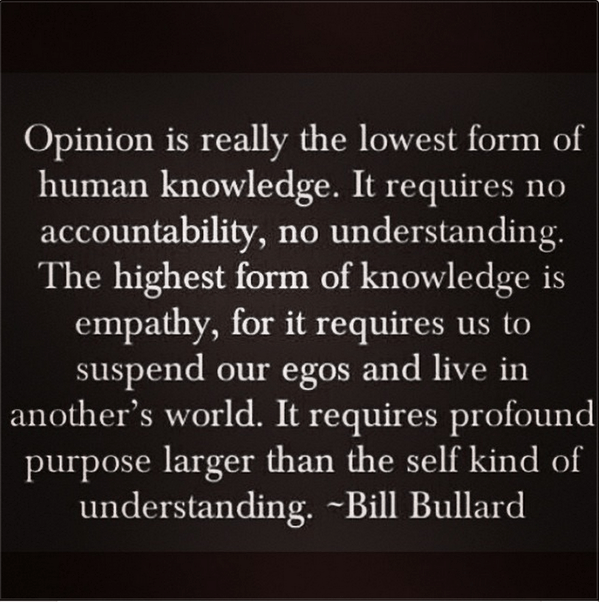
    Happen to just come across this image, and it just hit me to the core. I just kept reading about Empathy and Opinions in so many places. It really did not make me understand to clearly, a lot of my Mentors and the Leaders I like and follow mention about Empathy, this one just got into the depth and so precisely clear for anyone to understand and relate it. I am just writing this post just as a reminder for myself also as I have been quite vulnerable, not able to understand people and get driven sometimes, so it gets registered with me totally as well. My last post of a drive on expressway which I experienced with a friend had hit me hard too. This quote in my daily life it helps to explain my thoughts so much, as well as helps me to understand others better too. I happen to interact with so many people in person and online as well(friends, family, customers, acquaintances, etc.), it just helps me keep connected with it.  Also through the years in my personal life, I can relate so much, and when I see real innate people with glimpses of such qualities, it just drives me to them and their cultures. I found this video which was kind of interesting,

    Just sharing the thoughts so even I could regularly be alerted.  Hope the QUOTE IMAGE and the video above helps you with some new insights for yourself as well 🙂 and sharing with some might get more smiles :). Thank you for reading this up.

  • MUMBAI-PUNE EXPRESSWAY: AN EYE OPENER TO INDIAN INEQUALITY

    MUMBAI-PUNE EXPRESSWAY: AN EYE OPENER TO INDIAN INEQUALITY

    fotojet-collage

    India ranks 130th amongst the 188 countries on the Human Development Index, however, once inequality is factored in, we drop even further to rank 150th. In addition to employment strategies, the report calls for the government, civil society and private sector to work together and help to reduce inequality.  

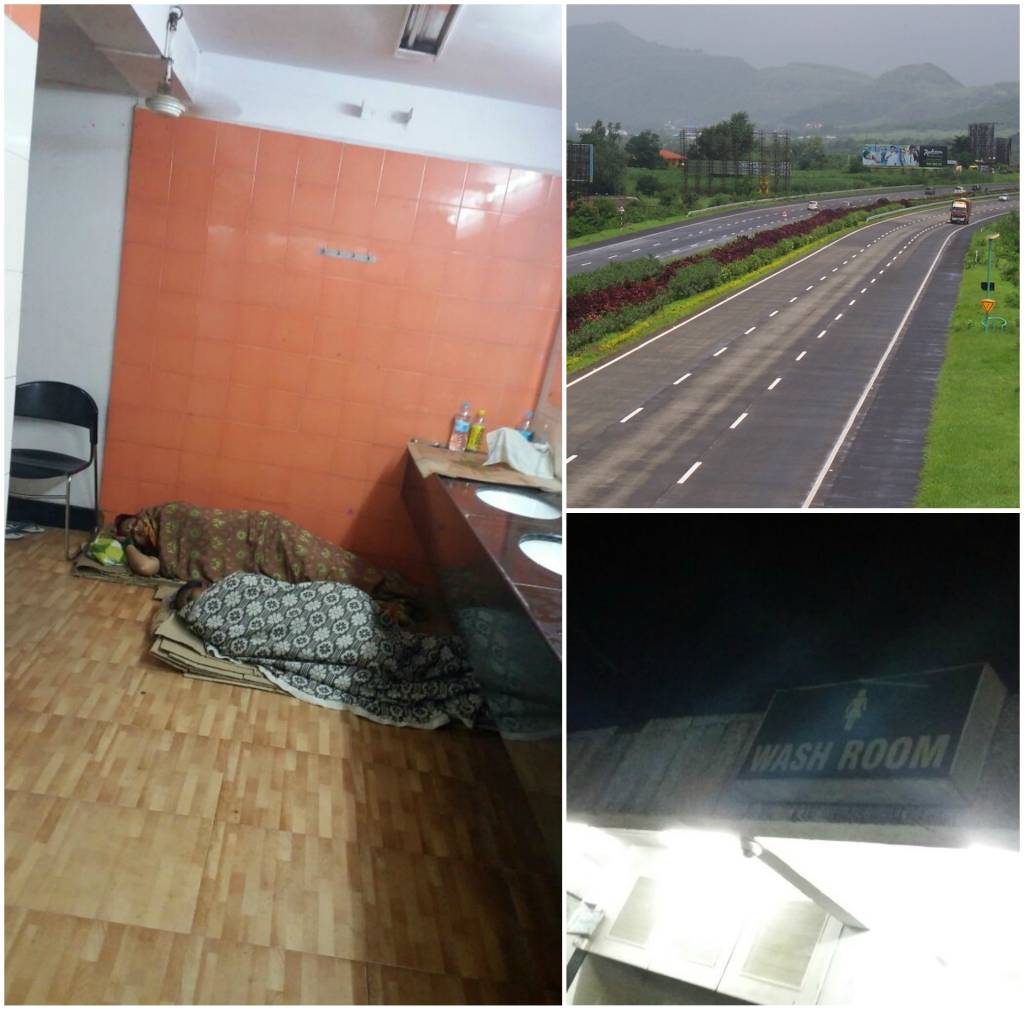
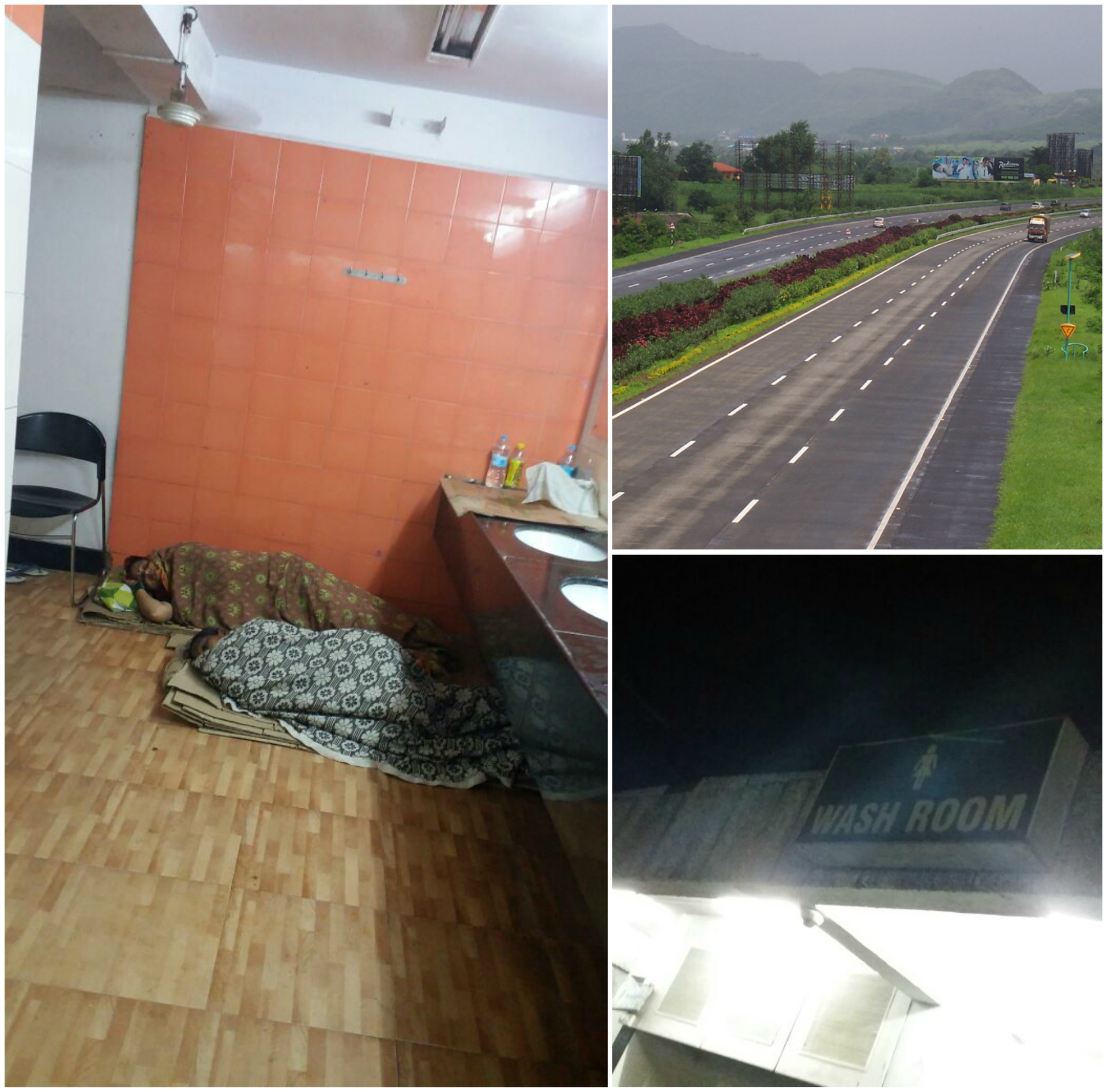
    One such incident we would like to put to your notice is whilst on the way to Mumbai driving from Pune to the second food mall beside the petrol pump. We witnessed two housekeeping ladies sleeping in the bathroom. Needless to say, this is a public toilet and the condition of the toilets added to our discomfort and shock. Considering the numbers of vehicles passing by daily on the Mumbai-Pune expressway would surely imply a staggering amount of visits to these public toilets. We noticed various people pass by in ignorance as if these housekeeping ladies were just meant to be sleeping in these public toilets. Adding to our shock further, we inquired further about these ladies only to find out they belonged to a village close by named Khopoli, and the salary they drew was a mere five thousand a month. We were also told that they had a strict 12 hours shift of tremendous hard work hour with a total of 45 minutes break. 

    Yes, we could provide them with a temporary solution by providing them help for those moments, but the point we are trying to make here is imagining similar working conditions throughout the country. We are not here to point out just one specific incident which massively impacted us. If the government could set a basic standard of living which will enable every citizen so that the survival of them and their dependents is acceptable it can address the situation. We cannot define the numbers but are sure that inflation and standard of living figures will be able to help as an estimate.

    What we are unable to figure out is if and who are the middle agencies who handle this, or the direct government system or the private sector who handles it. 

    We would not seek to point fingers at anyone in specific. 

    Our point is that we need a system which can work on more details in this sector and make sure that at least the basic rights a human deserves are being provided them. This can help ensure that overall our India’s issue of inequality can slowly and steadily be addressed. 

    Yes, we have passed the official message to the state and national government systems. 

    You could do your bit by liking, sharing and spreading the word.

  • Thailand Diary

    Thailand Diary

    Howdy  ,

    So my last vacation of my year was in Thailand, I just loved the vibes of that country, on a personal experience it had a blend of the feeling you get in India an Island as well. The moment I landed in Bangkok, I had this feeling same like Mumbai. And then boarded to the northern Serene part of Thailand known as Chiang Mai. It’s a beautiful, peaceful place.  The perfect peaceful destination for tourists just to go and chill and do some sight seeing.

    bne9ikujgb_
    Chiang Mai

    content

    Also, I had planned for Scuba Dive, which was a mind-blowing experience for me. The first 5 minutes were super challenging, but thereafter ones you get used to the equipment ,  breathing and the symbols technique its alright. I must say it was one my most special moments I have ever experienced. Also had been to the Highest Spot in Thailand Don Inanthon. Happen to spend time with some locals in a village who had their living with handmade handicrafts, the experience was one of a kind.

    bne9q2sdimp
    Highest Spot in Thailand