Tag: product-management

  • Leveraging AI/ML to Enhance User Activation and Engagements.

    Leveraging AI/ML to Enhance User Activation and Engagements.

    Innovative strategies are crucial for maintaining a competitive edge, particularly in user engagement and activation. This post outlines our integration of Artificial Intelligence (AI) and Machine Learning (ML) to significantly impact user experience and business outcomes for Mashkor. Our primary focus was on optimizing the experience for both first-time and existing users.

    Need

    Our journey was driven by a clear goal: to elevate activation rates for first-time users while simultaneously enhancing engagement for our existing users of the application. The challenge extended beyond introducing users to our platform; we aimed to ensure they discovered immediate value, encouraging ongoing engagement and improve a deeper connection with our services. To meet these objectives, we turned to the capabilities of ML and AI, focussing to create a seamless, efficient, and valuable user journey from their initial interaction.

    Initial Solutions

    Our strategy was executed in phases, acknowledging the intricate nature of user behavior and the diverse spectrum of their requirements.

    Phase One: Personalized Recommendations for First-Time and Existing Users

    The first phase of our initiative involved harnessing ML to tailor recommendations for both first-time and existing users, using a variety of input parameters to fine-tune these suggestions.

    For new users, we focused on their search terms and category interactions as a primary indicator of their immediate needs and interests. This allowed us to present a curated list of the most relevant stores, aiming to improve CTRs and, consequently, conversion rates. Google Vertex AI’s recommendation model was our tool of choice for this task, selected for its algorithms, compatibility with our tech stack and ability to scale efficiently.

    In addition to addressing the needs of new users, we also refined our approach for existing users by analyzing their past behaviors. This analysis and inputs included various parameters that enriched the personalization of their recommendations. Given their history with our platform, we anticipated that the model would yield faster and more accurate results for these users, enhancing their overall experience and satisfaction.

    We just initially decided to focus on batch recommendations and later evolve to real time recommendations.

    Phase Two: Refining the Model

    The second phase focused on refining our model to better achieve our goals of increasing activation for new users and bolstering engagement for returning ones. This stage involved iterative adjustments and enhancements, driven by continuous feedback and performance analysis. We also employed Generative AI in certain scenarios to create compelling copy, further personalizing the user experience.

    Challenges

    Adopting to ML came with its set of challenges. Initially, the limited amount of available data constrained our models’ predictive accuracy. Moreover, the success of these AI-driven solutions heavily depends on the quality of data, emphasizing the importance of sophisticated data collection and management strategies.

    Benefits

    Over time, the benefits of our AI integration became increasingly evident. For first-time users, the AI-powered recommendations facilitated a smoother discovery process, significantly improving their initial engagement with our platform. Existing users enjoyed enhanced personalization through the “Recommended for You” feature, which evolved to more accurately reflect their preferences and behavior patterns. These experiments helped us understand the impact of AI and ML on creating a user-centric, personalized experience. Integrating into our product was challenging, fun and rewarding.
  • Optimizing the Activation loop iteratively to improve the conversion for Mashkor App.

    Optimizing the Activation loop iteratively to improve the conversion for Mashkor App.

    Introduction

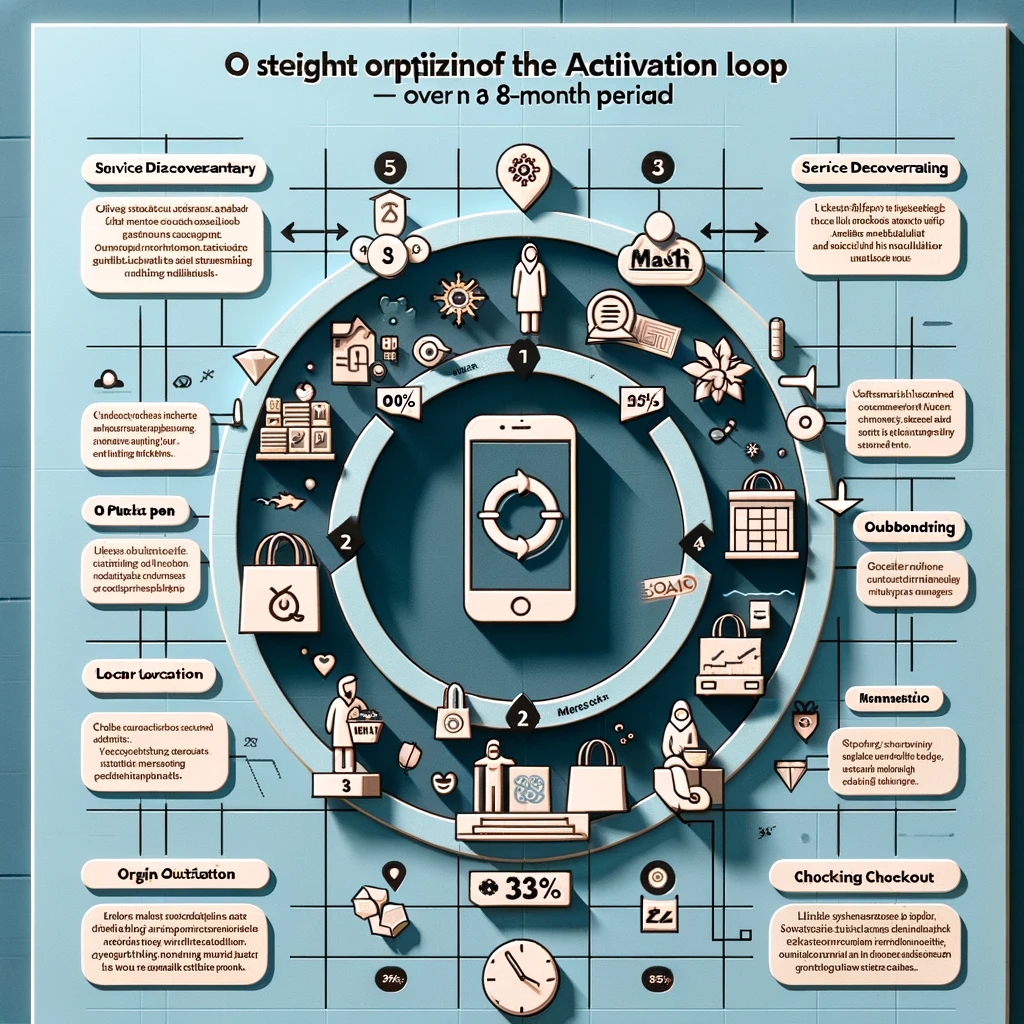
    • Wanted to share the story of working with Mashkor for the initial 8 months working here about how we worked to improve the activation loop, using two frameworks.
    • First, focussing with a user centric approach: Engage with users, understand pain points, iteratively develop the product, and refine based on feedback. And secondly implement the, Amazon’s working backwards culture and processes to execute.

    Outcomes and Stories of Specific User Groups

    • House wives of Kuwait.
      • These users have shown tremendous appreciation for our services, finding immense value in the convenience we offer for their daily outdoor errands and shopping needs. Their feedback highlights how our app has become an integral part of their household management, enabling them to save time and focus on their families.
    • Busy office Workers.
      • This group values our app for the support it provides in managing their errands amidst hectic work schedules. They appreciate the efficiency and reliability of our services, allowing them to delegate tasks seamlessly and ensure their personal outdoor errands are handled promptly, even during their busy office hours and beyond.

    Goal: Improve conversion rate.

    • User Segmentation
      • Organic New Users: Individuals who download the app through word-of-mouth.
    • Pain Points Validation
      • Key findings from qualitative and quantitative analyses with user research and product discovery phase revealed four major areas for improvement:
        • Service discoverability was low; core services were not immediately apparent to users.
        • Discovering and storing locations was cumbersome for users.
        • The cart and checkout process was overly complex, involving additional steps that deterred completion.
    • Iterative Solution Phases
      • Phase 1: Enhancing User Onboarding and Service Discovery
        • Objective: Make service discovery straightforward from the onboarding stage.
        • Strategies Implemented:
          • Revamped onboarding experience to prominently highlight services on the home page.
          • Introduced WhatsApp OTP as an alternative to SMS for verification.
          • Conducted A/B testing to optimize service discovery placements and design.
        • Success Metrics:
          • Increased adoption of WhatsApp OTP.
          • Higher click-through rates (CTRs) for service discovery.
          • Reduced time to conversion.
      • Phase 2: Streamlining Location Discovery and Storage
        • Objective: Simplify the process for users to find and store locations.
        • Strategies Implemented:
          • Integrated Google Maps for a more intuitive location search experience.
          • Simplified the selection process for Google-identified locations, requiring minimal additional information.
        • Success Metrics:
          • 80% success rate in selecting top location searches.
          • 90% efficiency in storing addresses.
          • Reduced time needed to store addresses.
      • Phase 3: Simplifying Cart Addition and Checkout Process
        • Objective: Make adding items to the cart and checking out smoother and more intuitive.
        • Strategies Implemented:
          • Overhauled the cart UX to consolidate steps and improve guidance.
          • Introduced Apple Pay to cater to user preferences and regional adoption.
        • Success Metrics:
          • 40% reduction in time to checkout.

    Conclusive Insights

    • Following these three phases and further optimizations led to 40% incremental improvement for conversion rate of.
    • The systematic framework emphasized understanding goals, breaking down problems, prioritizing impactful solutions, and iterating based on feedback.
    • This approach not only achieved the immediate objectives but also set a foundation for ongoing improvement and user satisfaction.